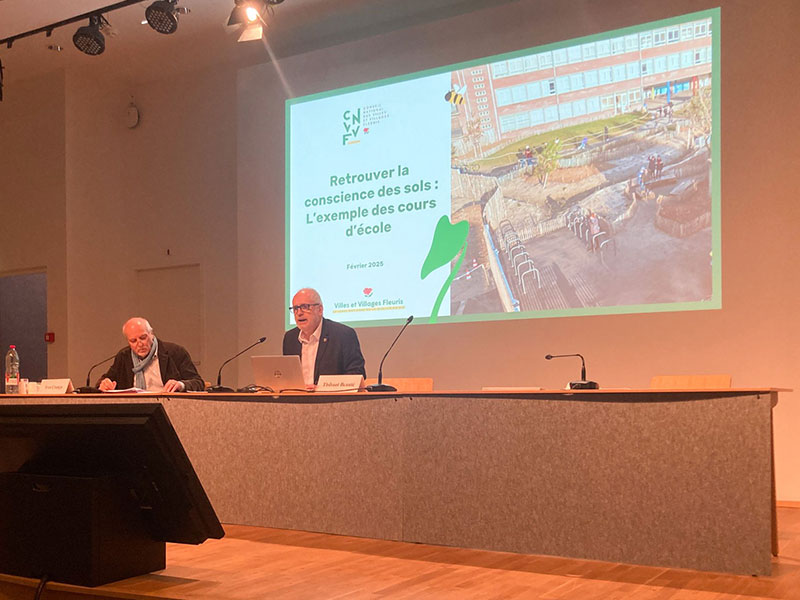


Thibaut Beauté, president of the National Council of Villes et Villages Fleuris CNVVF), spoke at the Ministry of Culture as part of an event dedicated to the transformation of urban spaces. This was an opportunity for him to highlightthe crucial importance of soil in the development of sustainable and resilient cities, and to propose concrete steps to restore soil to its rightful place in urban planning policies.
Rediscovering an Awareness of the Land and Rethinking Urban Planning
In his remarks, Thibaut Beauté emphasized the need to change the way we view urban soils, which are often seen merely as surfaces to be built on or paved over. Yet they play a fundamental role in the proper functioning of ecosystems: regulating stormwater, storing carbon, preserving biodiversity, and reducing heat islands…
Usingschoolyards as an example, he illustratedthe urgent need to “demineralize” public spaces. Reintroducing vegetation to these areas and rethinking their design and uses will allow the soil to regain its ecological functions while providing users—especially the youngest among them—with educational and resilient environments.
Inspiring examples from several towns and villages that have earned the Villes et Villages Fleuris designation
Several flagship projects were cited to illustrate how this “reclaiming of land ” is taking shape on the ground. In Dambach-la-Ville (Bas-Rhin), Dunkirk (Nord), and Bordeaux (Gironde), schoolyards have been redesigned to include green spaces, rainwater harvesting systems, and educational gardens. These initiatives, led by municipalities with Villes et Villages Fleuris, reflect a strong commitmentto integrating environmental concerns into urban planning, with visible results in terms of thermal comfort, biodiversity, and public awareness.